





Big Reads
Top Gear
"Hits like an avalanche": flat out in the 2,031bhp Hennessey Venom F5 Revolution Evo
Less a car, more a rocket ship: time to light it up
I understand the etiquette. Build up slowly. Get a feel for the power delivery. Work through the modes gradually before pulling the pin in ‘F5’ mode. That’s F5 as in the highest designation on the Fujita scale for tornadoes. It’s reserved for the devastating, sweep away all before them kind with wind speeds measuring up to 318mph. The Hennessey Venom F5 Revolution Evo generates up to 2,031bhp purely from a heavily turbocharged V8 engine and so more than justifies the dramatic billing.
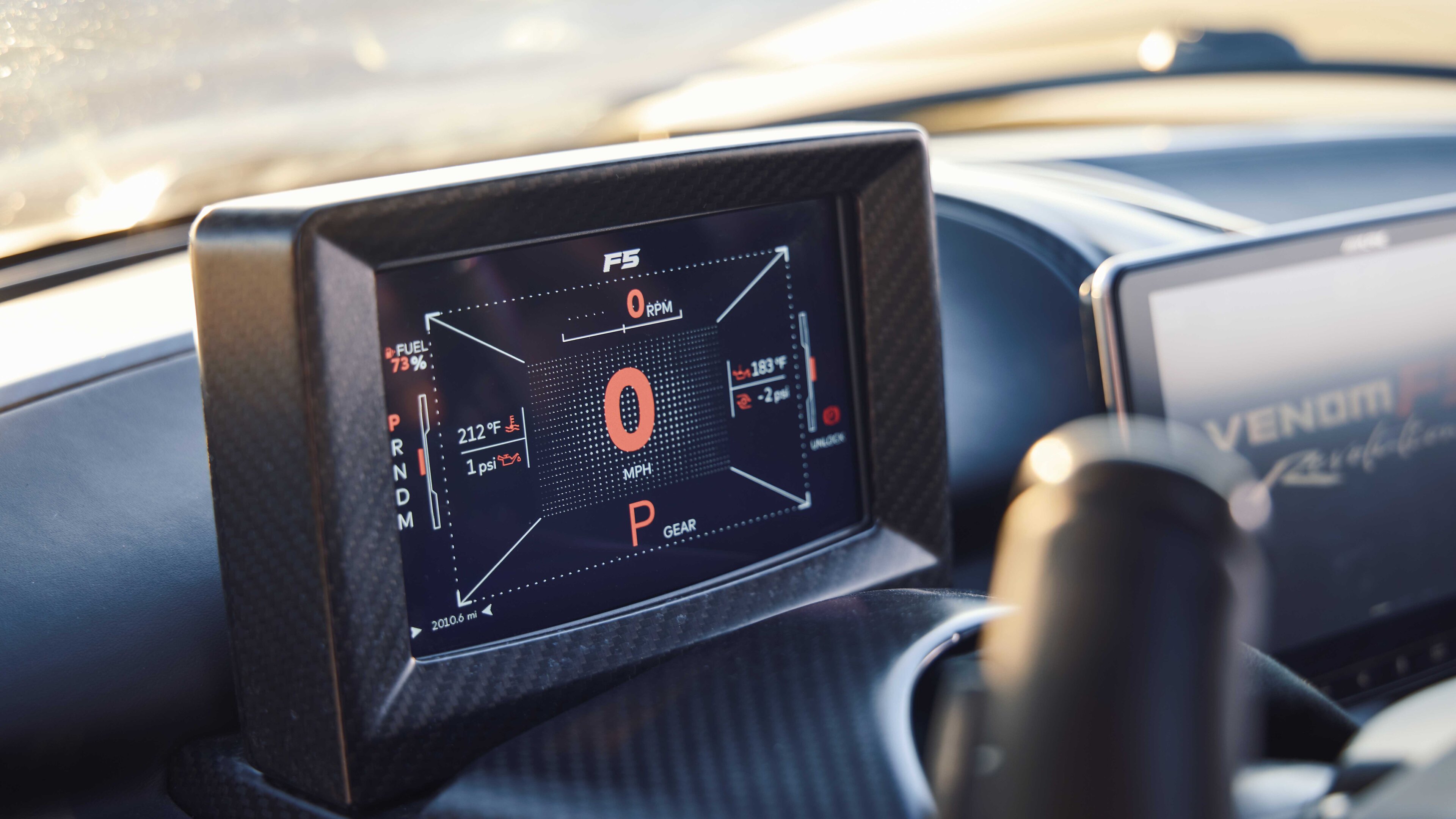
The handle with care approach seems sensible then, but also somehow deeply inappropriate. In fact, diametrically opposed to the philosophy of a car conceived and built to push boundaries, shatter lap records, burst through 300mph and extend a Texan sized middle finger to the establishment. Not wishing to dishonour the Hennessey Venom F5 Revolution Evo’s core values, I get just out of sight of the support crew, twist the manettino style switch on the steering wheel until the digital dash displays ‘F5’, and push the throttle to its stop.
Advertisement - Page continues below
The 6.6-litre twin turbocharged V8’s fire hose style fuel rails blast E85 into the combustion chambers and as the motor trips over 5,000rpm, all hell breaks loose. Despite the tarmac grazing ride height and super stiff springs, the Venom squats at the rear, the steering goes light and the world gets very blurry. For a few seconds it feels like the engine’s faintly absurd 1,445lb ft might just be speeding up the Earth’s rotation. The forces at work are too big to simply be attributed to normal surface bound acceleration. In the frenzy any screams would be inaudible, but my throat is so dry I can’t utter a word, anyway. But my brain is screaming, “Fuuuuuuuuuuuu…..jiiiitaaaaa”.
Photography: Greg Pajo



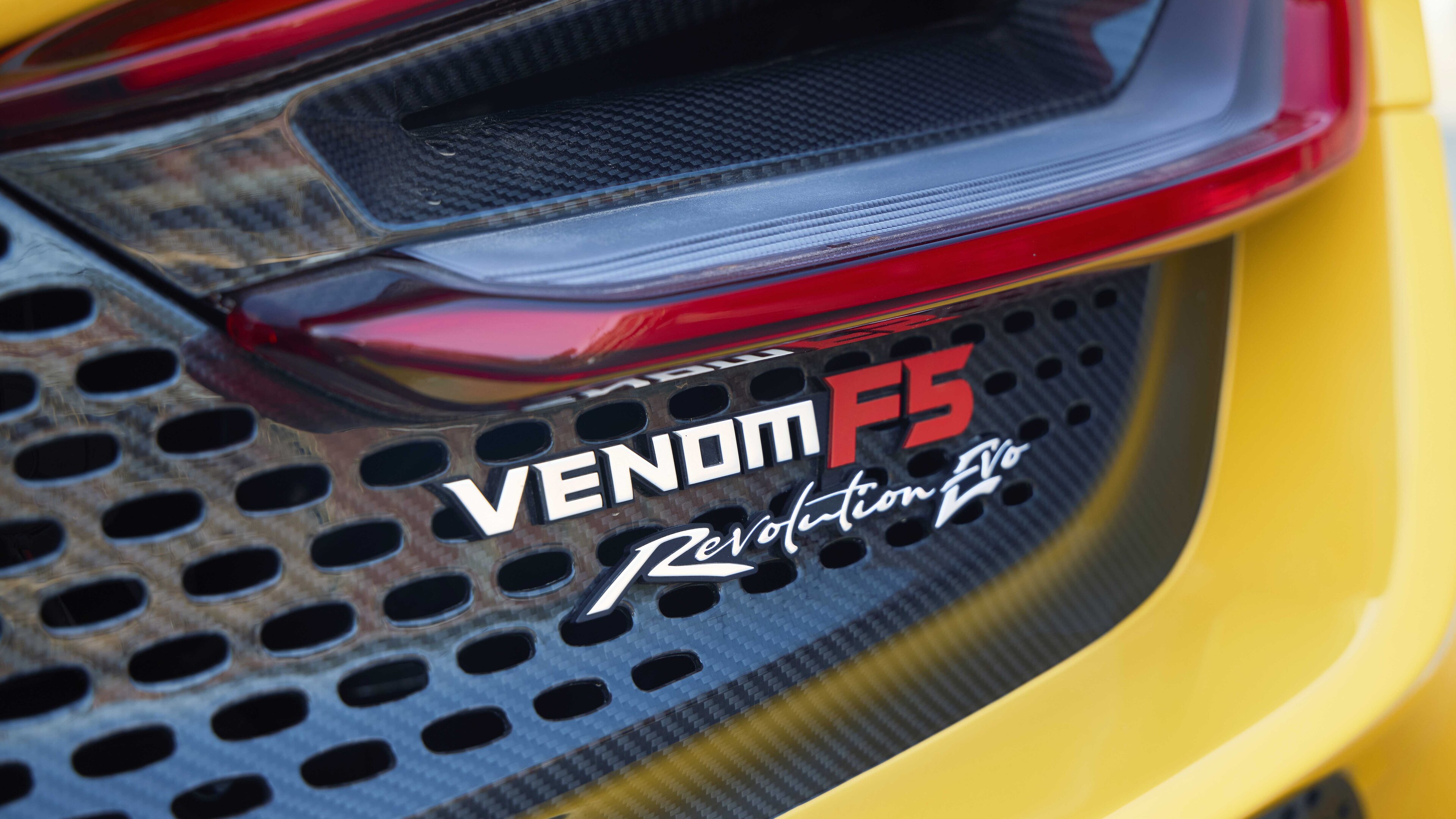
No question, the Hennessey Venom F5 Revolution Evo hits like an avalanche. A highly detailed upgrade over the already super endowed Venom F5, the Evo is the world’s most powerful internal combustion powered road car. It produces 2,031bhp at 8,000rpm and 1,445lb ft at 5,200rpm on E85... and Hennessey claims it can record 0–200mph in 10.3 seconds. At some point in the future the low drag version, simply called F5 Venom Evolution, will gun to set a new outright top speed record of well over 300mph. Stupid? Of course. Irrelevant? Undoubtedly. Kind of cool though, right?
For those of you wondering if the Hennessey is just an American made dragster in a hypercar body, let me attempt to disabuse you of that notion. Yes, Hennessey’s core business is making huge pickups and sedans go very fast indeed – or very slow but trailing a thick fog of tyre smoke – but the ground up, bespoke side of the operation is doing just fine. Hennessey will build 99 Venom F5s and has already delivered 30 units. This Revolution Evo costs from $2.75 million and the Evo package is also available as a retrofit package for $285,000. The lower drag model starts at $2.5 million.
Advertisement - Page continues below

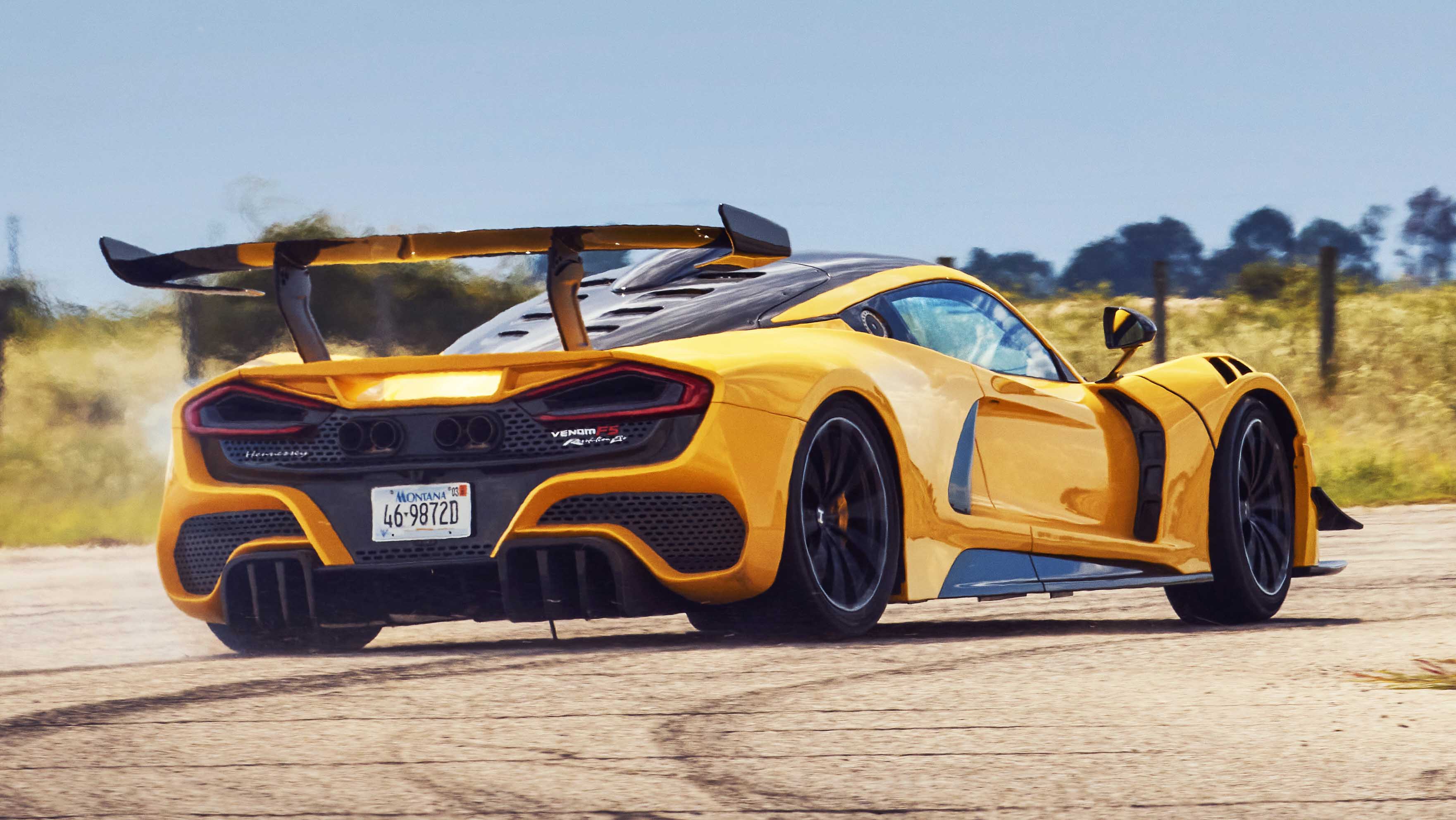
That success might well be founded upon a ‘Made in the USA’ patriotism, but the Venom F5 is a little more international than you might expect. For example, the carbon fibre chassis and bodywork is supplied by KS Composites near Melton Mowbray, which has worked on F1 projects and all sorts of specialised road cars from the Jaguar Project 8 to supercars they’re not allowed to talk about. The Evolution package, which consists of revised aerodynamics, suspension and an extra 214bhp over the original Venom F5, also benefits from the input of Multimatic aerodynamist Dr Mark Handford and Ilmor Engineering in Brixworth, Northamptonshire.
The involvement of Ilmor creates a lovely bit of motorsport influence. Its F1 operation was sold in 2005 and became Mercedes High Performance Powertrains and it continues to supply IndyCar teams. Even cooler is that in 1994 the company spotted a regulation loophole and developed an all new pushrod V8 for Mercedes called the 500l. It subsequently destroyed the competition, claiming pole at the Indy 500, and while Emerson Fittipaldi led much of the race, it was his teammate Al Unser Jr who'd go on to take the win. The 500l was immediately banned after this one event. The F5’s engine is the outfit’s second attempt at pushrods...
Looking for more from the USA?
Top Gear
Newsletter
Thank you for subscribing to our newsletter. Look out for your regular round-up of news, reviews and offers in your inbox.
Get all the latest news, reviews and exclusives, direct to your inbox.
Success
Ilmor’s thorough overhaul of the ‘Fury’ 6.6-litre twin turbocharged V8 sees the adoption of even bigger Precision 7680 turbochargers, oval billet aluminum pistons and connecting rods, titanium exhaust valves and higher flowing injectors. The engine is built in Northamptonshire, but sounds pure Americana and permeates the F5’s very being. Sitting in a mid-engined hypercar with a carbon tub and feeling it gently rock to the beat of a V8 engine like a 1960s muscle car is very cool indeed.
The seven speed, single clutch, paddle operated box gives a distinct thunk as it engages first gear – adding to the sense that there are serious forces at work – and the F5 rolls away rather grumpily. It will do low speed just fine as long as you have a sensitive right foot, but it’s apparent this isn’t really the Hennessey’s preferred way of going about the world. The yoke style steering wheel has lovely, low effort weighting, but the front tyres hunt around quite a bit and the ride quality is stiff even in the standard Sport mode. The Evo features new adaptive dampers by Tractive and they’re yearning for a smooth racetrack.
First impressions are slightly overwhelming, then. Yet there’s also familiarity from the strangest source. I’m in Texas but things feel oddly Norfolk. Hennessey’s first hypercar was the Venom GT and it was based on a Lotus Exige (albeit with a vastly extended footprint and stuffed with a V8). The F5’s DNA is very different but the shape of the dash and windscreen is similar and the narrow, carbon fibre seats must be based on Lotus’s old Probax chairs. Great claims for the comfort of these items were made when they were fitted to the Elise and Exige, but I always found them excruciating.
The F5’s are similarly tortuous for me, with the added bonus of violent acceleration to increase the pain. Obviously, customer seats can be tailored for a much better fit. That’s about where the Lotusness starts and ends. But the Evo does cherish that old adage about adding lightness and thanks to its pure ICE formula and an intensive focus on weight, it tips the scales at just 1,360kg dry. The Fury takes a lot of lubrication and cooling, so that figure is likely to increase quite a bit with fluids, but the power to weight ratio is still off the scale. For context, a Lotus Emira comes in at around 1,450kg ready to roll and we recently weighed a Valkyrie at 1,340kg including a full tank of fuel.
18 minutes 53 seconds
On a surprisingly twisty road just outside the little town of Fayetteville, Texas, the F5 feels light, responsive and if you swim around below 5,000rpm the performance is strong but not otherworldly. That’s a good thing. After my first foray into the upper reaches the acceleration is so violent that it seems best reserved for a closed environment and definitely requires much respect. The fact that this engine can produce 307bhp per litre and yet has good throttle response well before the turbos are blowing hard is pretty remarkable. I almost feel relaxed.
The general sense of wellbeing is enhanced by fabulous brake feel and the surprisingly well mannered box. There’s a reason big carmakers have moved towards dual clutch setups despite the weight penalty, but this CIMA box hits clean and hard under full load and works well at lower speeds as long as you gently reduce pressure on the throttle as you pull for an upshift. The F5 is loud and the extreme power is tangible even at low speeds but there’s just enough sophistication to mitigate the brutal, raw energy of the experience.
Wind things up a notch or two and the F5 starts to make you work. The suspension is too stiff for this environment (I later learn the spring rate on this car is a test setup for the upcoming high speed runs and should be ‘almost halved’) and the combination of bumps and boost sends the car snaking down the road. To be honest, traction is much better than I expected but the rampant torque does send the car weaving like a heavily boosted FWD car on a narrow British country lane. Deploying even a fraction of the available power on the road seems slightly insane, but it would be nice to feel more confident when lunging between corners.
Imagine that first freefall sensation on a rollercoaster continuing without end. That’s the Venom F5 Revolution Evo
In some ways my expectations are turned upside down. I’d envisaged devouring straights in the blink of an eye and then a slightly clumsy, inert feel through the turns. Instead, the F5 comes to life in the corners. Once the chassis is loaded, it settles down effectively and exhibits lovely balance. It carves cleanly into each curve and fades into very mild understeer mid corner. Keep the rear tyres under load and that reassuring, secure phase then shifts and you sense the outside rear tyre is now the critical point of balance.
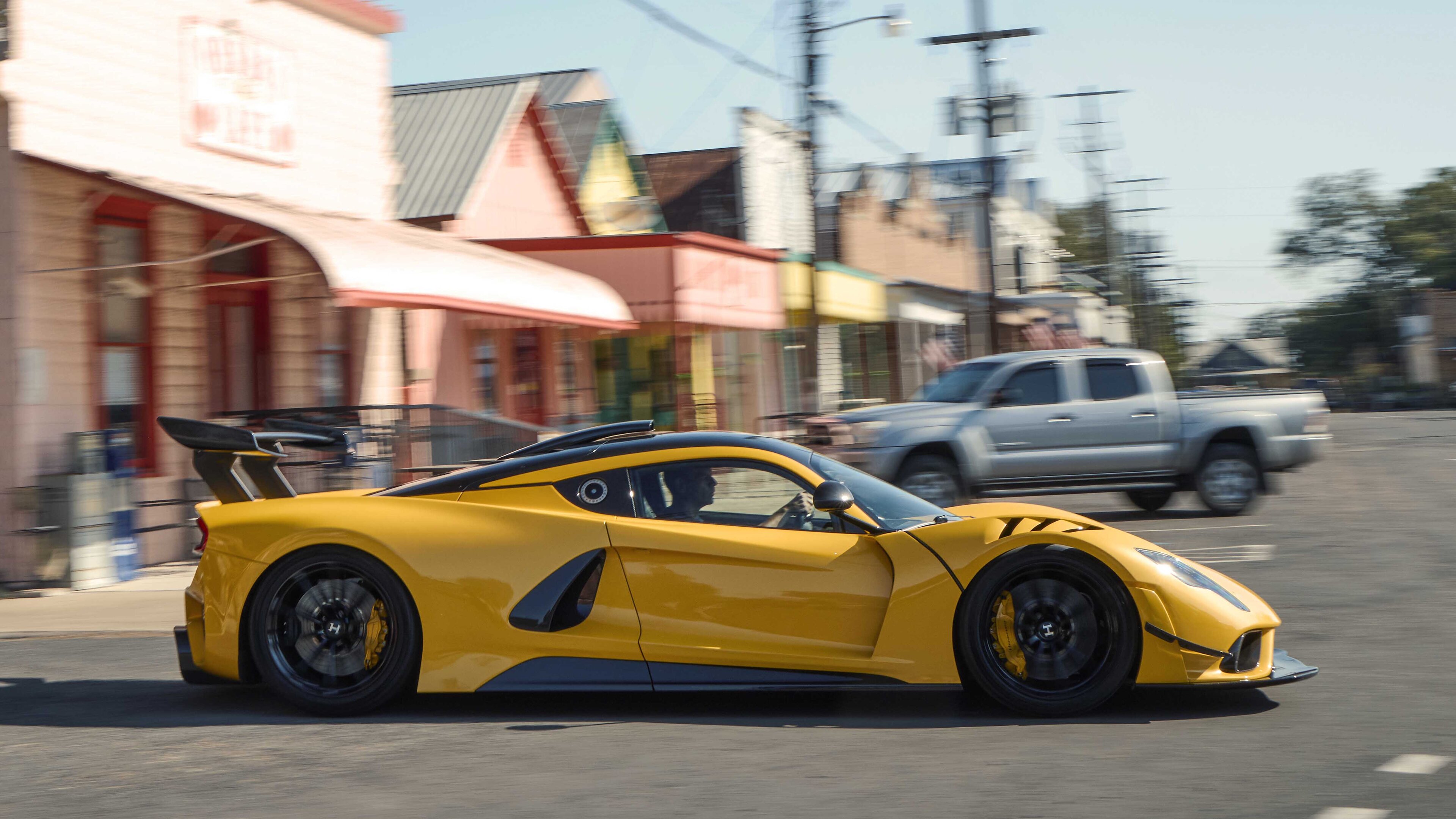
You’ve got a savage sounding hypercar right in its sweet spot and it feels so easy, all that power enabling rather than disturbing the car’s perfect trajectory. As the corner fades to straight you can even push into a little bit of slip at the rear with real confidence. The Revolution might wear dive planes, a huge front splitter, new wheelarch vents and a massive rear wing in search of downforce, but at road speeds it feels progressive and adjustable.
On Hennessey’s own test facility it’s possible to explore this side of its capability in more detail. Perhaps wisely, the F5’s traction control can’t be disabled, but in the default Sport mode (there are also Wet, Drag, Track and F5), the systems are nicely judged. Now I’ve got ‘just’ 1,300bhp with which to play, but the Fury motor still feels about as furious as any other engine giving its all.
However, the chassis displays a softer, cuddlier side. I can pitch the car in hard off throttle to get the tail swinging, pick up the power and lean right into the traction control systems to hold the angle for the length of an entire gear. The Venom F5 Revolution Evo is raw and can feel like sensory overload at times, but beneath the booming power delivery there’s a fundamentally well sorted and exploitable supercar.
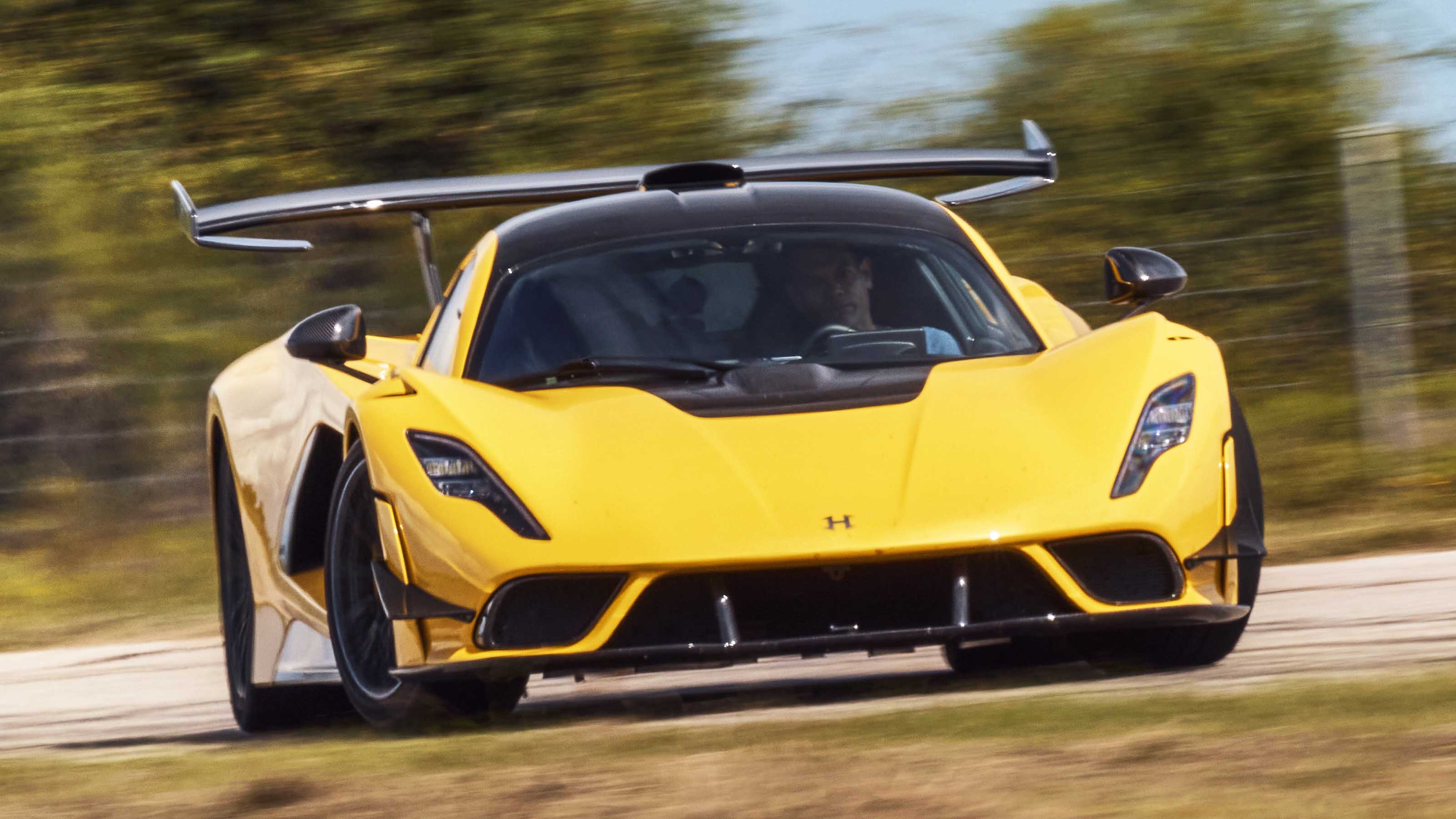
The next party trick is Drag mode and a full launch control start with 2,031bhp. It hurts. It’s hilarious. It’s remarkably controlled – although the traction control does a heavy cut at about 135mph over a little bump, which speaks to the intensity of the acceleration – and as simple as can be. Hold the brake pedal down as far as you can, pin the throttle and wait for the graphic reading ‘Boost building’ to be replaced by ‘Ready to launch’. Release the brakes and you’ll be at 150mph before you know it.
Hennessey limits torque by gear ratio and so the full might of the V8 only comes on stream in third gear, but from the driver’s seat these nuances are impossible to detect. The Evo’s resources to throw you into the horizon feel limitless.
The sensations are so different from an EV hypercar: less initially shocking but much more exciting and the way the big turbos build boost and keep on building to the rev limit creates a feeling of exponential, supernatural power. Every time your brain starts to calibrate just what’s happening the delivery seems to ramp up still further. The Fury engine’s relentless power is always a step ahead. Imagine that first freefall sensation on a rollercoaster continuing without end. That’s the Venom F5 Revolution Evo at full noise. It is wild. And addictive.
So, crunch time. Is the Hennessey a viable alternative to more blue blooded hypercars from the old world? I think the answer is yes, with some caveats. Firstly, that headline grabbing 2,031bhp output reduces significantly to 1,300bhp on more regular ‘pump gas’. Here in the UK there are precisely zero E85 outlets. In the US around 2.4 per cent of stations have E85 and in Europe the picture is mixed, but still relatively bleak if you want to regularly fill the heart of a 6.6-litre twin turbocharged V8. Now, 1,300bhp is a lot. But it isn’t 2,031bhp.
This is a really good car that feels slightly in thrall to its massive power output
Take away the ingredient of simply being the biggest hammer out there and you might start to look more closely at other hypercar attributes and wonder if the Hennessey is on the same level. The exquisite detailing of a Pagani Utopia, for example. The pure, wondrous tactility of a GMA T.50. Or the simply stunning completeness and motorsport pedigree of a Ferrari F80. The benchmarks are impossibly high.
For me, the Venom F5 Revolution Evo is all about its ability to shock. It’s about that engine and the outrageous, unhinged character. Fundamentally this is a really good car that feels slightly in thrall to its massive power output. Take that away and it’s still pretty dazzling but the compromises made to tame the full 2,031bhp start to make less sense. Ironically, if it was designed from the ground up to have 1,300bhp, I suspect it would be all the sweeter and more enjoyable on the road.
A killer car then and a huge achievement. But now Hennessey has established itself in this rarefied air, I hope its next model isn’t quite so concerned with unheard of power outputs and smashing the 300mph barrier and instead focuses on unleashing the very obvious potential lurking beneath. Having said that, I won’t forget firing this thing off the line in a hurry. It was Fujita-ing unbelievable.
Hennessey Venom F5 Revolution Evo
Price: $2.75m
Powertrain: 6.6-litre TT V8, 2,031bhp, 1,445lb ft
Transmission: 7spd auto, RWD
Performance: 0–62mph in n/a secs, 318mph (est)
Weight: 1,360kg (dry)
Trending this week
- Car Review
Renault Clio
- Car Review
Hyundai Kona