

the fastest
345kW xDrive50 M Sport Pro 113kWh 5dr Auto [Tech]
- 0-624.9s
- CO20
- BHP462.7
- MPG
- Price£64,390
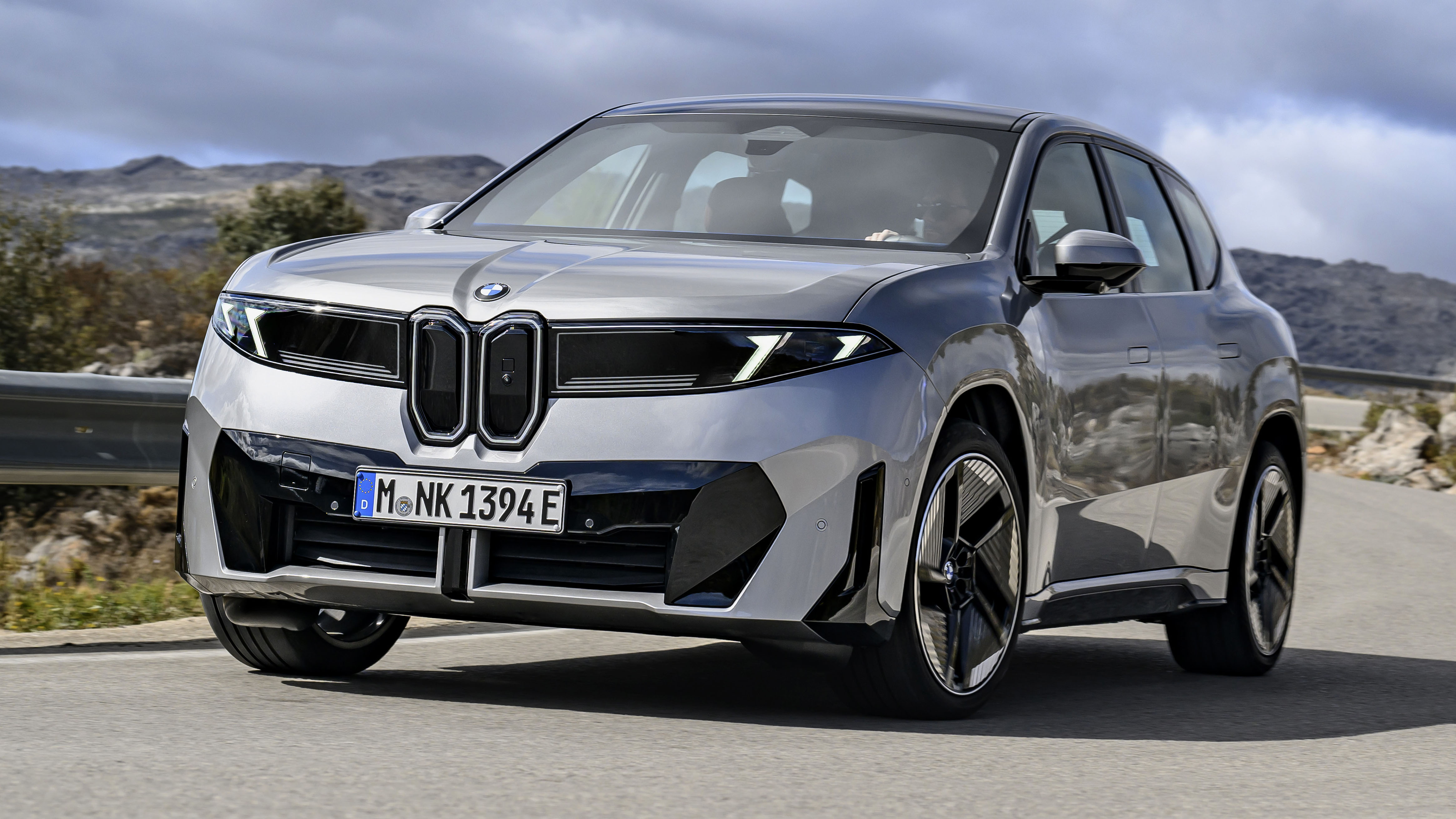
Like a real BMW ought to. Not like a bulky EV crossover, or soulless digital-first zombie-mobile. Cornering and ride match a particularly well set-up AWD 3 Series. But the powertrain is vastly smoother and more responsive.
It's relaxed when the going's easy. It holds true to a straight line and peels into curves with an intuitive weight and gearing to the steering, brakes and accelerator pedal.
But get a wiggle on and it feels remarkably content. Electric crossovers tend to throw their weight around, but this one staves off roll, heave and pitch. It doesn't understeer if you have to tighten your radius. It's polite even in simultaneous inputs of brake, steering or accelerator, and even when the road bowls you a googly with a dip or crest.
It's organic and engaged: you can feel the power going to the rear, and the steering lightening when the front tyres can do no more. Even in the wet.
In short, it feels like it's about a tonne and three quarters. The real figure is 2,285kg plus driver.
Remarkably, it does all that without active anti-roll, or 4WS, or air springs or even adaptive damping. Actually if it had those things it'd be heavier. No, the key – apart from BMW's long-held skills in body stiffness, suspension geometry and damping – is something called the ‘Heart of Joy’.
No honestly it really is a thing, not just a winsome slogan knocked out on a Friday afternoon at the ad agency.
The Heart of Joy is a single integrated processor that controls all drive: the motors, regenerative braking, traction control, ESP, steering assistance. Plus, when added, all the dynamic suspension systems the iX3 doesn't yet have – or need.
As a single processor it can react with lightning speed, and integrate signals coming in from multiple sensors and going out to the steering assistance, as well as to the motors which of course can take advantage because they're far more quick-witted than an ICE powertrain.
So if you're losing grip, the HoJ can magic up the right torque from each motor and adapt the steering weight and even brake a wheel. Because it can do it instantly and even predictively, what you feel is progressive and intuitive.
The iX3 uses regeneration, not friction, for about 98 per cent of braking events. Great for efficiency of course. But also it gives the pedal an impressively consistent feel because it's not juggling two different retarding forces. Also, the thing comes to rest with an uncanny absence of jerks or creaks – you really can't point to the exact moment it has come to rest.
Long years of passengering have taught us that most drivers don't give a monkey's for smooth progress in traffic jams, but this car is better even than chauffeur-oriented petrol Rolls-Royces. The iX3 engineers call it the sheer joy of stopping.
That's smooth too. Really not much to say – it just accelerates as you want, whether that's gentle or quite brisk enough. If you demand something more brutal, step up to a Turbo-badged Porsche or Performance Tesla, or wait for the inevitable M-badged BMW versions.
There's a switchable synthetic sound, and it gives a useful extra connection with what the car's up to.
Back in 2017, before launching the then flagship iX, BMW said that car would be more or less self-driving door-to-door in many parts of the world, by 2023. No way can it, even now. So the claims for the Neue Klasse have been scaled right back.
The phrase they use is co-operative driving. Basically, if you're on the case it won't nanny you. When the systems are on (and there are handy controls to switch them off) they don't grab the wheel and accelerator. They subtly work with you. If you're following a sensible course and the monitor camera sees you're looking ahead, it lets you take a smooth curve that might mean slightly transgressing a white line. If you change lanes without indicating, but you've looked in the mirror, it won't yank the wheel or sound an alarm. You can brake or accelerate while the cruise control is still on and it won't immediately cancel.
Yeah it has some party tricks. If you come up behind a slower car and look in the overtaking mirror, it'll indicate and change lanes automatically. If there's an obstacle like a parked car that blocks your urban lane it'll gently brake then steer round it if there's space. Not just beep deafeningly, flash red, and jam the brakes on.
Its self-parking uses AI to great effect, making it super-easy to use while still giving you the choice of which space you go for and which way you end up pointing. This stuff all works very well. We tried the fancy lane change and parking in test track demos, and used the lane keeping on the road.
But it's a significant moment that BMW has stepped back from an arm's race of hype and recognised what we all knew: in 2025, ‘self-driving’ is still for the birds. That said, the onboard sensors and actuators and processors and in-cloud connectivity are powerful enough that when it's ready (and people outside China and LA actually want it) ‘self-driving’ could be switched on.
Thank you for subscribing to our newsletter. Look out for your regular round-up of news, reviews and offers in your inbox.
Get all the latest news, reviews and exclusives, direct to your inbox.