


Tech

Top Gear
This hydrogen-powered V6 racecar is here to save the combustion engine
Bosch has converted a Maserati V6 to run on hydrogen with barely any emissions. And it still sounds absolutely brilliant…
This is the future, but it sounds very much like the past.
From the outside, racing nerds will tell you it looks just like a Ligier JS2 R – essentially a sports car with its own one-make race series that usually uses an FIA homologated tubular chassis, fibreglass bodywork and a mid-mounted Ford V6 engine.
Advertisement - Page continues below
However, this particular car was created as a collaboration between the French motorsport firm and Bosch Engineering, the latter describing itself as a “global engineering partner for customised, cross-domain mobility solutions”. Whatever that means.
Anyway, Bosch Engineering is part of the wider Bosch Group, which is the largest automotive supplier… in the world. And yes, the group does also include companies that make fridges, washing machines, power tools, ovens and vacuum cleaners.


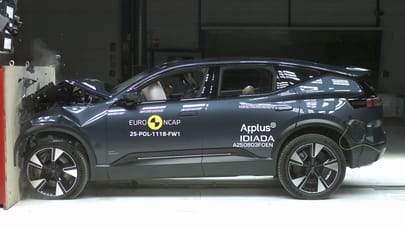
And yet, this particular Ligier is powered by an extremely interesting motor. Essentially, it’s Maserati’s 3.0-litre twin-turbo Nettuno V6 from the MC20 supercar, but Bosch’s boffins have adapted it to run on hydrogen. Hence the name JS2 RH2.
This isn’t a fuel cell vehicle where hydrogen is used to generate electricity that in turn powers silent motors. It’s a properly rowdy combustion engine, but one that now emits just 0.8g/km of CO2 – and apparently 0.7g/km of that comes from the ambient air. For context, the current Suzuki Swift with its little 1.2-litre petrol engine and mild-hybrid system emits 99g/km of CO2. This very car could be about to save the internal combustion engine. And yes, TG has had a go.
Advertisement - Page continues below
We were treated to a couple of very quick passenger laps of the handling circuit at Bosch’s Boxberg proving ground in Germany. Conclusion? It’s LOUD.
Bosch retrofitted the engine with specific hydrogen injectors, new ignition coils and spark plugs, plus a new ECU, and… that’s about it. No modifications at all were required to the block, the combustion chamber, the pistons, the type of oil or much of the cooling system. Pretty neat.
Of course, the setup does require a complex piping system with many safety sensors and valves. Don’t want any hydrogen getting anywhere it shouldn’t. It also needed Ligier to deploy the carbon monocoque from its LMP3 car with a completely custom frame at the rear. So yeah, it’s not really a JS2 R at all underneath. It gets a new exhaust system too, although because it’s super clean the catalytic converters cost about a quarter of the ones usually used for petrol engines.
Wrapped around the sides and rear of the cabin are three carbon fibre high-pressure tanks designed to store 6.3kg of gaseous hydrogen at 700 bar. We’re told that these came from a hydrogen fuel cell car that’s currently on sale in Europe, meaning they started their life in a Hyundai Nexo. The only other option was a Toyota Mirai, but that only holds 5.6kg of hydrogen.
Top Gear
Newsletter
Thank you for subscribing to our newsletter. Look out for your regular round-up of news, reviews and offers in your inbox.
Get all the latest news, reviews and exclusives, direct to your inbox.
Success
With its new planet-friendly power source, the engine now makes 594bhp and 502lb ft of torque, but Bosch already has a Gen2 variation on a test bench making 641bhp and 649lb ft. It reckons hydrogen combustion could unlock 20 per cent more power than petrol in the near future when shown a like-for-like engine.
Although from where I’m sitting, the JS2 RH2 seems plenty powerful enough already. The acceleration is punchy, and the hydrogen’s rapid ignition means it sounds raspy and almost a little unhinged at the top end of the rev range. Formula E, eat your heart out.
I forget to brace myself for the braking zone at the end of the short circuit’s back straight, and immediately I’m contemplating booking in with the chiropractor. Bosch hasn’t done any lightweighting yet on this test mule, so it tips the scales at around 1,450kg but still stops like a proper racecar and feels nicely balanced through twisty sections. The hydrogen system adds around 130kg, but just swapping out the MC20’s standard 8spd dual clutch for a proper racing gearbox could buy back as much as 100kg. It certainly doesn’t have the extra heft of an EV.
Our time in the car comes to an all-too-speedy end and the JS2 RH2 sits in the pits with a deep V8-like burble and only the smell of brakes and Michelin Pilot Sport Cup 2 tyres. It’s as tricky to get in and out of as any race car, and the sills sweat through the carbon fibre interior panels as the hydrogen tanks behind begin to recover to ambient temperature. They drop to as low as -20 degrees Celsius when the car is under load. Switch the thing off completely and it takes around 10 seconds to go quiet as the system clears the high-pressure rails before shutting down. Those are the only clues as to how special this car is.
Unfortunately, we can’t do any more laps today because the nearest hydrogen filling station is an hour away and the car would need to travel there on the back of a truck. And there lies one of the major problems with the technology: the infrastructure.
Bosch’s engineers seem confident that there will be plenty of green or natural hydrogen to go around in the future, but at the time of writing there are fewer than 10 filling stations in the UK. Could motorsport be the key to improving this? If major circuits start to install refuelling stations, they could start cropping up everywhere. The Bosch Group also has all of the tech required to develop its own stations.
Clearly, the hydrogen combustion engine technology is basically there. This particular collab was first unveiled on a stand at the 24hrs of Le Mans in 2023, and in the two following years the car took part in demonstration laps ahead of the famous race. It has also clocked up over 3,500 miles during testing, and now TG has signed it off too.
It should take between three and five minutes to refuel, it doesn’t cost much more than a petrol-powered motor to build, and it allows manufacturers to retain special engines as their USP. Hydrogen-powered Lamborghini V12 or McLaren V8? Yes please. It also means our ears will continue to be blessed with glorious combustion noise.
Bosch says that its next steps are to work with supercar manufacturers to transfer this tech to road cars, but the governing body behind the 24hrs of Le Mans also wants to see a hydrogen-powered car actually contesting the race in 2028. With a filling station in the pit lane and a bit more hydrogen on board, the JS2 RH2 could well be that car.
“We still want drivers to have fun with the vehicle,” says senior product manager Lionel Martin among lots of supremely technical chat about air-fuel ratios, hydrogen storage and electrolysis. “We would never have reached where we are in just two or three years without motorsport.”
We’re already dreaming of a grid full of hydrogen combustion race cars. All the noise, almost none of the carbon emissions. Surely, it’s the future?